Premier League clubs spend millions trying to gain an edge on the pitch. The next competitive advantage may be the one supporters experience long before kick-off.
Today’s clubs don’t just play football anymore. They’re media brands, ecommerce businesses, membership platforms and community organisations.
A supporter might watch highlights on YouTube, buy a shirt through the club shop, search for transfer news on Google, renew a season ticket in an app, open a matchday email or ask ChatGPT who starts up front on Saturday. Every interaction shapes how supporters experience the club.
We wanted to understand which clubs do that best.
Mediaworks analysed every Premier League club using MX (Measure of eXperience), our digital performance model, measuring Brand, Reach, Authority, Technical performance and Engagement.
Arsenal finished first with a score of 442.2, ahead of Liverpool, Manchester United and Manchester City.
The rankings tell one story. The data behind them tells another.
Across the Premier League, every additional 10 MX points is associated with approximately £22.5 million in annual revenue. Clubs with stronger MX scores also tend to have larger fanbases (r = 0.85) and stronger league performance (r = 0.56).
Better websites don’t win football matches. But clubs with stronger digital ecosystems appear better equipped to turn supporters into long term commercial growth.
What MX measures
MX brings together five areas that influence long term digital performance:
Brand
How well known and trusted your organisation is.
Reach
How visible you are across search, AI search and social platforms.
Authority
The trust signals that influence rankings, recommendations and credibility.
Technical
The quality, speed and accessibility of your digital experience.
Engagement
How effectively your digital channels encourage meaningful interaction.
But, just like on the pitch, a club can’t rely on one strength.
Huge engagement can’t hide technical weakness. Strong search demand can be wasted if the journey is slow. High authority is useful, but only if people can find and use the experience.
The best digital performers remove weakness across the full journey. Total football.
The Premier League Digital Performance Index
Arsenal finished top of the Premier League Digital Performance Index with a score of 442.2 out of 500.
Liverpool followed closely on 435.4. Manchester United ranked third with 403.5. Manchester City came fourth with 379.9, ahead of Spurs on 365.3. 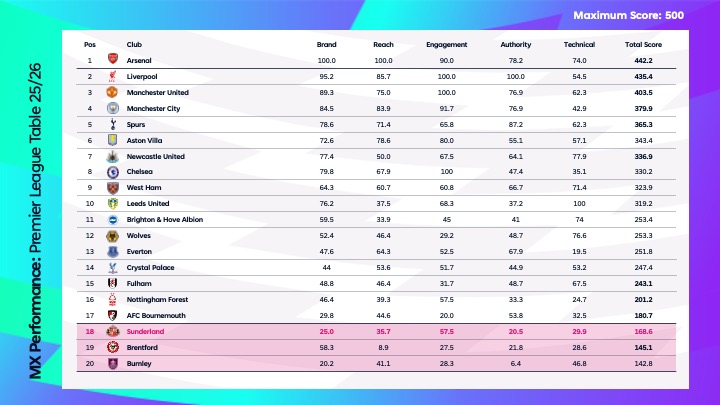
Arsenal don’t dominate every pillar. They win because they’re strong everywhere.
They score 100 for Brand, 100 for Reach and 90 for Engagement. Their Technical score of 74 is solid. Their Authority score of 78.2 keeps them competitive with the strongest clubs in the league.
That balance is the difference.
Liverpool are exceptional in Authority and Engagement. Manchester United still have huge engagement power. Leeds lead the league technically (who would have thought it?). Chelsea have elite Engagement but weak Technical performance.
Arsenal have fewer gaps.
Five things we learned from the data
Arsenal have the strongest all round squad.
Arsenal didn’t finish first because they had the league’s top scorer.
Liverpool outperform them for Authority. Leeds top the Technical rankings. Chelsea and Manchester United match or beat them for Engagement.
Arsenal came first because they have quality across the pitch. There are no obvious weak links. The same is true of strong digital brands. Success rarely comes from one outstanding channel. It comes from building a team without passengers.
Liverpool’s Authority is like having Virgil van Dijk at the back.
Liverpool are the only club to score a perfect 100 for Authority.
Authority isn’t built overnight. It’s earned over years through reputation, history, media coverage, backlinks and trust. Like a commanding centre back, it gives everything around it more confidence. Once you’ve built it, every attack starts from a stronger position.
Manchester United still fill the stadium.
Manchester United score 100 for Engagement despite mixed fortunes on the pitch.
Results change. Habit takes longer.
Supporters still search for them, watch them, debate them and share their content because some clubs become part of people’s routines. The biggest football brands don’t need to introduce themselves every season.
Chelsea have the crowd. The stadium needs work.
Chelsea score 100 for Engagement, but only 35.1 for Technical performance.
Fans keep turning up because the badge is strong. But if the turnstiles are slow and the concourses are overcrowded, eventually the experience starts to affect the atmosphere. Digital works the same way. Brand strength can hide friction for a while, but it rarely does so forever.
Newcastle have built the technical foundations. Now they need more fans through the gates.
Newcastle rank seventh overall and post one of the strongest Technical scores in the league, ahead of Arsenal, Liverpool, Manchester United, Manchester City, Spurs and Chelsea.
Their foundations are already in place. The opportunity isn’t rebuilding the experience. It’s increasing Reach and Authority so more supporters discover what they’ve already built.
The surprise performer: Leeds United
Leeds rank tenth overall, but they score 100 for Technical.
That’s useful because it shows why the total score needs context. Leeds don’t rank tenth because their digital platform is poor. They rank tenth because Reach and Authority pull the total score down.
For Leeds, the opportunity is clear.
The foundations are there. The next job is to build visibility and trust around them.
The gap at the bottom
The lower end of the table shows how diagnostic the model can be.
Sunderland rank 18th overall with a total score of 168.6. Their Brand score is 25.0, Reach is 35.7, Authority is 20.5 and Technical is 29.9. Engagement is stronger at 57.5, putting them closer to mid-table in that category.
That changes the recommendation.
The issue isn’t simply 'digital performance is weak.' The sharper diagnosis is that Sunderland have an engagement base to build from, but need to improve discoverability, authority and technical experience.
That is where benchmarking becomes useful. It tells you where the drag is.
What the correlations tell us
The strongest relationship in the analysis is between MX score and social following.
An r value of 0.85 suggests the clubs with stronger digital ecosystems also tend to have larger fanbases. That makes sense. Fanbases grow through history, performance, geography and culture, but digital experience helps clubs capture and maintain attention between matches.
The link with league performance is also positive, with an r value of 0.56.
Better digital experiences don’t score goals. But stronger clubs often have more mature commercial operations, bigger fanbases, larger content teams and more investment behind their platforms. Digital strength tends to travel with broader organisational strength.
The commercial relationship is the one club executives should pay attention to.
Every additional 10 MX points is associated with roughly €26.3m in annual revenue. Again, this is correlation, not causation. But if digital maturity repeatedly appears alongside fanbase size, league strength and revenue, it shouldn’t be treated as a soft marketing metric.
It’s a signal of commercial readiness.
What businesses can learn from the Premier League
The best performers do five things well.
They create demand before people search.
They show up when people do search.
They build enough authority to be trusted.
They remove friction from the user journey.
They turn attention into action.
They go beyond football. A housing association trying to improve resident self-service has the same challenge. So does an energy supplier trying to build trust, a retailer trying to reduce checkout friction, a university trying to attract applicants or a healthcare provider trying to make booking easier.
The channels change but the tactics remain the same.
Brands that are easier to find, easier to trust and easier to use are better placed to grow.
The Premier League table shows who wins matches.
The Digital Performance Index shows who is best placed to win attention.
Methodology
MX (Measure of eXperience) is Mediaworks’ digital performance model. It benchmarks organisations across five weighted areas.
Brand measures demand, recognition and preference.
Reach measures visibility across search, AI search and social channels.
Authority measures trust, credibility and backlink strength.
Technical measures site performance, accessibility and technical experience.
Engagement measures user behaviour, action and loyalty.
For this analysis, every Premier League club was scored out of 500 possible ranking points. Scores were then compared with wider indicators including social following, league performance, commercial value and community impact.