January 29 2026
Why creativity is the most powerful driver of performance

Performance marketing is having a moment in 2026. Budgets are being scrutinised harder than ever, attribution is still messy, and clients want growth now, not “green shoots” in six months.
But there is a problem hiding in plain sight: for most businesses, performance marketing isn’t underperforming because the platforms are broken. It is underperforming because the creative isn’t doing enough heavy lifting.
Creative effectiveness is no longer a “nice to have”. It is one of the biggest controllable levers brands have to improve efficiency, reduce waste, and unlock meaningful performance gains.
This is why creative effectiveness has become critical in 2026, and how businesses can turn it into a competitive advantage.
Creative is the biggest contributor to sales in an ad campaign; it’s more impactful than targeting. (LinkedIn 2025)
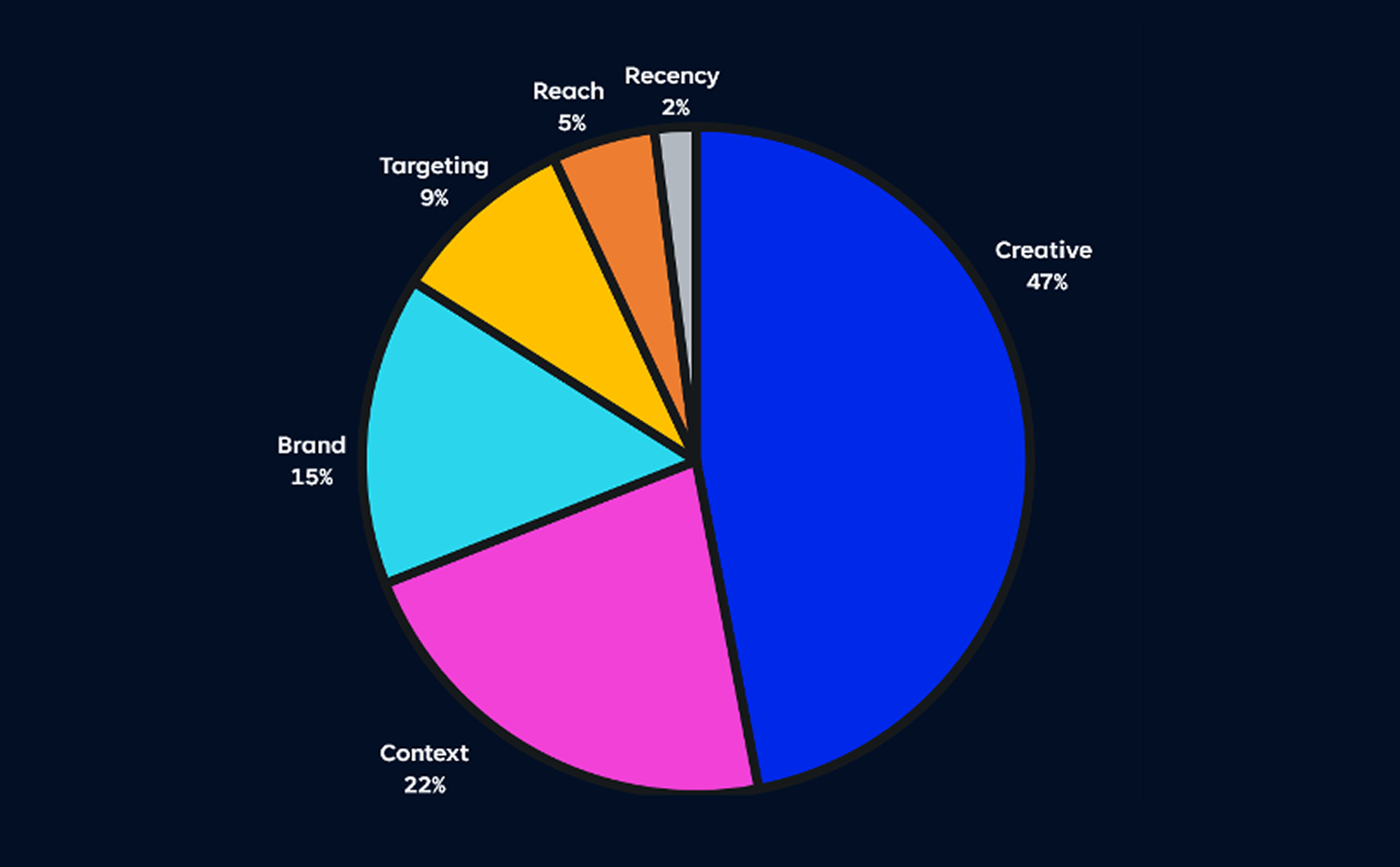
The performance marketing problem in 2026 is not what most people think
When marketing performance falls short, the instinct is often to blame:
Budget levels
Targeting limitations
Platform changes
Competition inflation
All of these are valid issues. But in many cases, they are symptoms rather than root causes.
The real issue is that too many organisations treat performance marketing as a channel problem, when it can be a creative and proposition problem.
If the creative does not generate attention, communicate value quickly, and compel action, then:
CPMs rise because engagement is poor
CTR and conversion rates stagnate
Platforms struggle to optimise effectively
Retargeting becomes a crutch
Spend increases without proportionate results
The result is missed opportunity, even when strategy and media buying are sound.
Why creative effectiveness matters more now than ever
In 2026, platforms like Google and Meta are leaning harder into automation and machine learning. That means:
Audience selection is increasingly automated
Bidding is increasingly automated
Delivery is increasingly automated
Creative is one of the last meaningful variables you control
Creative is now the input that most heavily influences whether the platforms can do their job properly.
If you feed the machine weak creative, you get weak outcomes.
If you feed it strong creative, you unlock better performance at lower cost.
That is the reality of modern performance marketing.
Creative effectiveness is the difference between “running ads” and driving growth
There is a major difference between being active on performance channels and being effective on them.
Creative effectiveness means your ads consistently:
• Cut through quickly
• Communicate the proposition clearly
• Align to audience intent and motivations
• Reflect brand assets and distinctive cues
• Drive action without relying on discounts alone
This is what improves marketing efficiency and effectiveness, because it increases the likelihood that every pound spent delivers value.
The opportunity: turbocharge performance through creative
Most businesses are sitting on a major opportunity: they already have campaigns running, they already have spend, they already have data.
What they often do not have is a system to:
Audit what is working and what is not
Identify patterns across formats, messages, and categories
Build a scalable creative library tailored to platform behaviour
Refresh assets consistently to prevent fatigue
When you solve that, you stop wasting budget on underperforming assets and start building campaigns that improve over time.
The impact is significant.
What great looks like: proof from real campaigns
Creative effectiveness is not theory. When it is applied in performance channels with the right strategy, results follow.
Here are examples from campaigns referenced in the presentation.
Metro Bank Invoice It: creative-led multi-channel performance
This campaign ran across Meta, Performance Max, YouTube and proximity OOH, delivering:
+4% business account opens
+3.3 pts top of mind brand awareness
85k online branch visits

CR Smith: seasonal activation with a full Performance Max asset suite
CR Smith’s largest ever summer activation used data-driven insight to identify key trading periods and build a structured seasonal plan. A full suite of Performance Max assets was deployed, driving a 75% month-on-month increase in leads.

Why “performance creative” is becoming a distinct discipline
In 2026, leading brands are treating performance creative as its own capability.
That means building creative for performance channels that is:
Iterative, not campaign-only
Built in modular formats for rapid variation
Designed for platform-native behaviour (scrolling, sound-off, mobile-first)
Measured and optimised like media, not treated as finished artwork
Supported by an always-on asset pipeline to prevent fatigue
It also means creative teams and performance teams working as one unit, rather than handing work over and hoping for the best.
A practical approach to improving creative effectiveness
The presentation outlines a structured four-stage approach to performance creative improvement.
1) Insight
A session and review that outputs a structured insight board (e.g., Miro), ensuring creative decisions are rooted in real audience, brand, and performance context.
2) Review
A structured audit of existing assets, with scoring, a full asset inventory, and a summary deck of performance patterns.
3) Define
A “best in class” framework that identifies what is needed to raise quality and performance, including new creative concepts, design directions, and production costings.
4) Produce
Scaled production based on what has been defined: full asset creation, a toolkit approach, or an ongoing creative retainer model to keep campaigns fresh and aligned to seasonal or hero activations.
This turns creative effectiveness into a repeatable process, not a one-off fix.
Why this matters commercially for businesses in 2026
Creative effectiveness is critical in 2026 because it directly impacts:
ROI and ROAS
Cost efficiency (CPM, CPC, CPA)
Platform optimisation and learning
Audience growth and conversion rate
Brand impact alongside performance metrics
In other words, it is one of the most reliable ways to improve performance without simply spending more.
And because it strengthens client outcomes and results, it also creates stronger commercial outcomes for agencies and partners:
Increased revenue per client
Better retention through measurable results
Clear cross-sell into other channels and services
Stronger strategic position as a growth partner
The key takeaway
In 2026, performance marketing is increasingly automated. That means creative is the differentiator.
Brands that invest in creative effectiveness will:
outperform competitors on efficiency
scale faster with fewer wasted impressions
build stronger performance and brand impact together
turn performance marketing into a growth engine rather than a maintenance cost
The brands that do not will continue to fight rising costs with diminishing returns, even with good strategy and good budgets.
Creative effectiveness is no longer optional. It is critical.
Are you ready to unlock the potential of Creative for Performance Marketing? Contact us at info@mediaworks.co.uk and we will get back to you right away to go over the information we need from you.