July 03 2026
Why 85% of campaigns fail. And how to plan one that doesn’t.

85% of marketing campaigns fail to prove a return on investment. Still, many organisations are still planning campaigns and budget as though their channels are speaking to a captive audience who are at the buying stage of the customer journey.
In our latest Mediaworks Masterclass, COO David Norris sat down with Strategic Planner Becca Frend to unpack why these campaigns fail to deliver, how to better understand your audience, and how to create campaigns that unite your digital channels for one audience and one purpose.
It’s funny as a digital marketing agency to say that 85% of marketing campaigns fail, but we see time and time again how disjointed channels can hold businesses back, despite an abundance of marketing activity and data.
Why the Buyer Journey Has Outgrown Old Planning Models
One interesting statistic that Becca raised during the session was that ‘95% of B2B buyers aren’t actively in the market at any given moment.’ Meaning that campaign activity needs to do both jobs; capture those 5% who are ready to buy right now and build demand amongst those that aren’t, so that when the time comes, your brand is front of mind. Gone are the days when campaign planning follows a linear path of awareness, interest, and conversion. Today’s buyers are more educated than ever before, even before they reach your site, as they research products and services through other channels, such as social media or AI-powered search experiences through the likes of Google’s AI overview.
We concluded that the three things effective campaigns all have in common are:
Understanding your audience
Before the marketing activity even starts, a clear understanding of your audience is the baseline for a successful campaign. That means analysing your customer list, understanding where recent enquiries and lead generation are coming from, and mapping the customer journey that leads up to that point.
First-party data is the biggest differentiator for any business. It shows who is already engaging, converting and buying, and can be used alongside platform-level data further down the funnel to sharpen targeting and improve performance.
Audience intelligence tools such as GWI can then add another layer of insight. They help build richer audience personas by exploring what your customers care about, what motivates them, what stops them buying, which channels they use, who influences their decisions and what messages are most likely to land. This moves audience planning beyond basic demographics and gives campaigns a clearer view of the real behaviours, barriers and purchase drivers that shape decision-making.
One connected message
Once your audience is defined, the next stage is determining what you actually want to say to them and making sure that messaging lands at the moment the buyer wants to hear it. This is where consistency is key across all activity: visual and written messaging, video, and even the mix between UCG and polished content. A mismatch in tone, branding or imagery could be the different between making sales and losing out on them.
Channels with purpose
Most businesses are already active across a wide variety of channels, The issue we see isn’t presence across those channels, but a lack of clarity on how the channels work together with a simultaneous goal. Not every channel needs to do everything. Some are built for awareness, others for consideration, and some for the final conversion. Understanding how they all piece together prevents both duplicated efforts as well as coverage gaps.
What is the Biggest Problem in Campaign Planning?
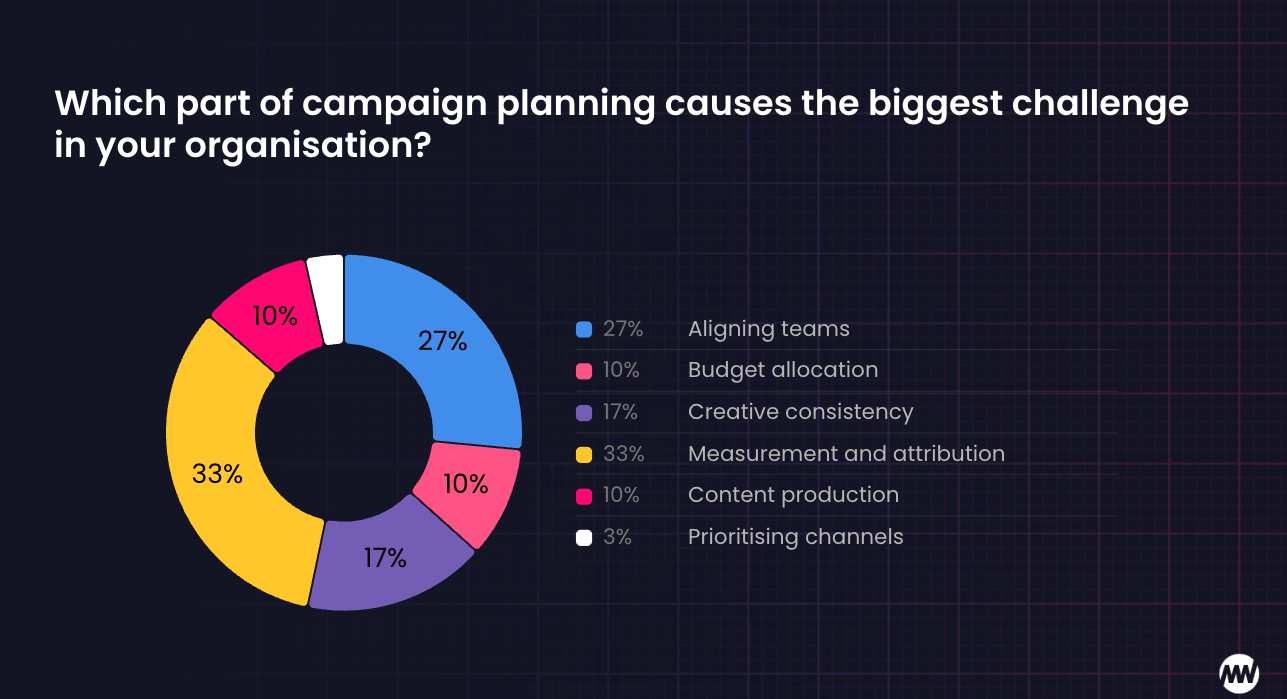
During the session we asked the audience, what their biggest challenge when campaign planning was and found that answers were spread across multiple touchpoints.
33% of marketing leaders on the call said that measurement and attribution was their biggest challenge, 27% said that it was aligning internal teams and another 17% said that creative consistency was a problem.
If your team is facing any of the challenges, Mediaworks can help to plan joined-up campaigns that speak to your audience needs, drive demand and convert that demand in to growth.
We’ve covered how channels working in unison yield the best results and ROI. Every channel should contribute to one campaign rather than run one of its own.
What that means in practice:
Grounding activity in real audience data rather than assumptions
Building a single, clear campaign message before choosing channels
Giving each channel a dedicated, defined role within the wider strategy
Making sure brand, creative, and tone of voice are consistent across all channels
The businesses that consistently land in the 15% aren't necessarily doing more. They're doing it in a way that's genuinely joined up: one audience, one message, and a defined, measurable role for every channel involved.
To help you see how your own marketing and digital experience compares, we're offering a FREE Digital Performance Audit. The audit benchmarks your organisation's marketing and digital experience across five key pillars, drawing on millions of data points spanning everything from brand search to LLM visibility and website speed to accessibility to give you a combined digital performance rating.
You'll receive a clear view of how you compare against your competitor set, along with the priority opportunities to improve visibility, engagement and commercial performance.
You can request yours here